Lanai Flooring Options in Brevard County, Compared
We put down five kinds of lanai flooring in Brevard County. Three go over the slab you already have: a knockdown spray texture, a stamped overlay or thin pavers. The other two start fresh, with full pavers after a tear-out or a new broom-finished slab.
Here a lanai means the concrete slab under a covered patio roof, a pool cage or a screen room. The deck right around the pool has its own page, pool deck resurfacing. Your slab decides which floors are open, and height, heat, grip, days of work and upkeep decide the rest.
We lay pavers and pour concrete, so every floor your slab allows gets priced on one visit. The prep behind the first three is on our patio resurfacing page. Tile and outdoor rugs are other floors people weigh, and this guide compares the concrete and paver options.
What are the five lanai flooring options?
A knockdown spray texture coating is the thinnest of the five. A cement-based mix gets sprayed over the old slab, then flattened with a trowel to create a smoother finish. You get a gritty texture in the color you pick, sealed last to resist stains.
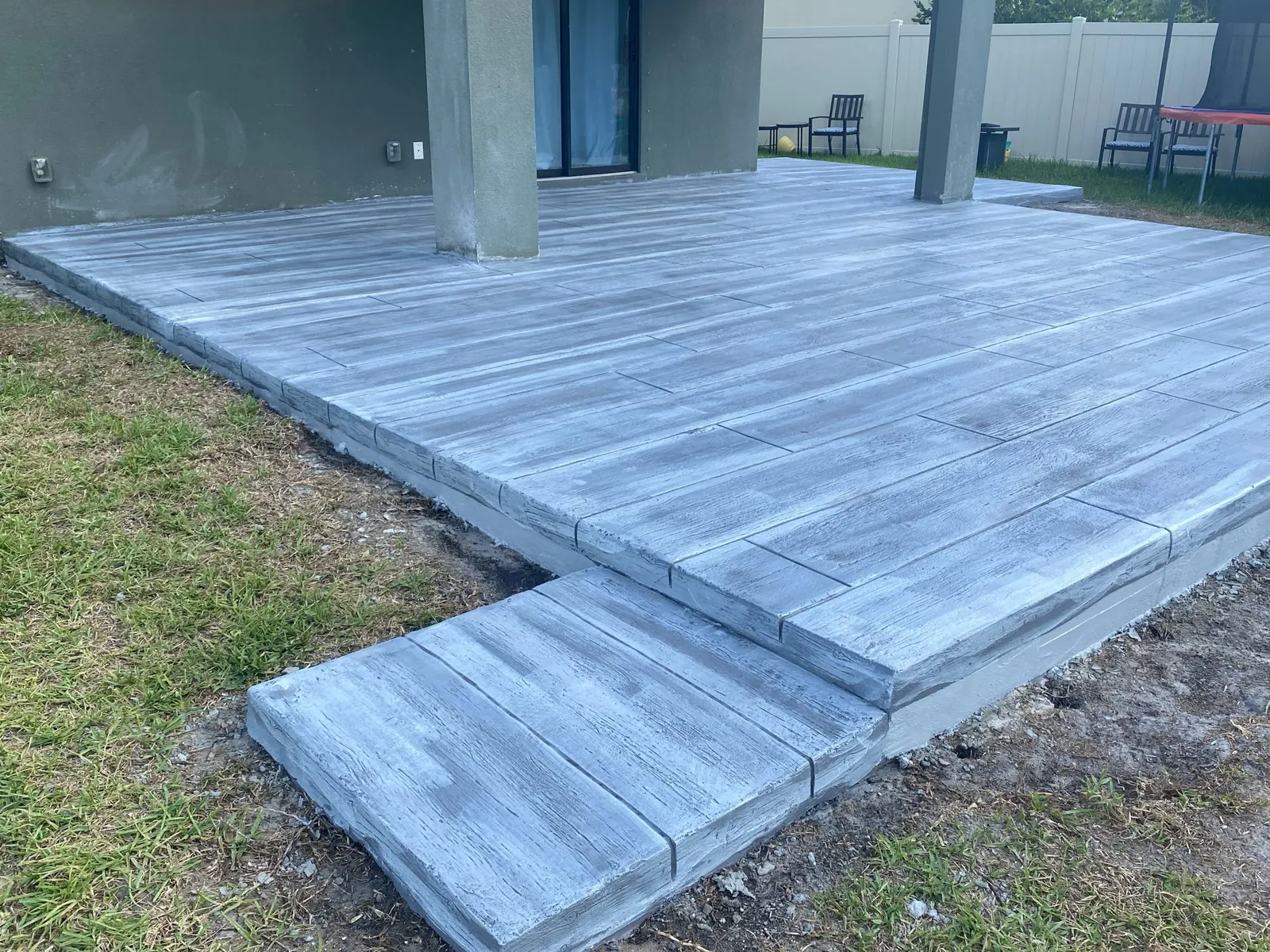
A stamped concrete overlay bonds a polymer mix to the old slab, and a pattern gets pressed into it. We stamp ashlar slate, flagstone, brick and wood plank patterns.
Thin pavers set over concrete give you a real paver floor without a tear-out. The pavers run about an inch thick and sit right on the old slab. The slab carries the load and the pavers carry the look.
Full pavers replace a slab that has failed, or carry the floor past its old edge. They go down on a dug out, compacted base with bedding sand, edge restraint and polymeric sand joints. Our page on under lanai paver patios covers that build.
A new or extended slab is the plain option, poured with a broom finish. Plenty of Palm Bay homes came with a small slab under the lanai. An extension makes room for a table and chairs. That pour is covered under new concrete patios.
Is your lanai slab sound enough to cover?
Every overlay sits on the old concrete, so the slab sets the limits. Screened lanai floors work well, since the slab sits protected and usually stays in good shape.
Movement is what rules a slab out. One resurfacing guide says it is not feasible to resurface concrete that is heaving or has severe cracks. Crumbling edges and rebar showing through point to a tear-out too. Brevard’s sandy soil drains fast but settles, so a patio corner can drop well after the pour.
Slope matters too, since rain and pool water have to run off. A spray texture is thin enough to follow existing slopes and contours rather than leveling them out. Under thin pavers, the slab’s slope still has to carry the water off. Where puddles sit for days, we can build slope back into an overlay or cut in a drain.
A slab that passes is a good candidate for concrete patio resurfacing. A slab that fails comes out, and full pavers or a new slab take its place. Either way, the sand under the new floor gets compacted before anything goes on it.
How much height does each lanai floor add at the slider?
The slider track and the door threshold set the limit, so we measure them before quoting. A spray texture barely changes the floor height, so both stay about where they are.
A stamped overlay adds a fraction of an inch, and deeper patterns need more material.
Thin pavers lift the floor about an inch and a half once the setting bed is counted. That shows up first at door thresholds and slider tracks. Full pavers and a new slab get built up from the base, so we set the finished height. We keep a paver floor level with the door threshold.
Which lanai floor stays cooler and grips when wet?
Color drives most of the heat you feel underfoot. Lighter shades reflect more solar energy, while darker shades absorb more heat. That rule holds for every paving material here, so a light spray texture helps. Shade from the screen cage helps too on the worst days.
A lanai does not stop wind-driven rain the way glass does, and swimmers drip pool water across it. In shaded or damp areas, moisture can linger longer. Algae can make pool decks, patios and walkways much more slippery when wet.
Texture and sealer decide the grip. The highly textured surface of a spray texture is slip resistant. On a stamped overlay, slip resistance depends largely on the sealer used, so ours gets a grit additive. A broom finish leaves fine lines with grip, while a smooth trowel finish turns slick in the rain.
How long does each lanai floor take, and when does furniture go back?
A spray texture is the quickest. Plan on a day or two of work on most decks, then a day or two of cure time. Light foot traffic is usually fine after about forty eight hours, and furniture goes back after roughly three days.
A stamped overlay usually runs two to four days on site. Light foot traffic is fine about a day after the sealer dries, and furniture waits a few days. Thin pavers on most porches and patios are done in two or three days. We tell you at handoff when you can walk on them.
Full pavers take more days, and on a failed slab the tear-out comes first. Most backyard paver patios take three to five working days. Give the joint sand a day to set before you walk on the patio.
A new slab is usually one day of prep and one day to pour. You can walk on it after about a day, and furniture can go back after a few days.
Summer rain stretches every schedule. Most of the county’s rain falls from late May into October, and some of it blows through the screen. A fresh overlay has to be protected from rain and moisture until it can be sealed. In summer we start early and watch the radar.
How does each floor work around the screen enclosure?
Most Brevard pools sit inside a screened lanai, and the cage shapes the work. The aluminum base track and the posts sit right on the slab. No machine fits through a screen door, so material moves by wheelbarrow or gets pumped in. That is slower, but it keeps your cage intact.
Before a spray texture goes on, everything the spray could reach gets taped and covered in plastic. Thin pavers need saw cuts at posts, drains, screen tracks and curves. Their border courses get set first along every edge, bonded so nothing creeps outward.
Full pavers get laid around the post footings and the screen track. A new slab plans for the cage another way, because screen rooms bolt into the slab. The edge has to be thick enough to hold the track. Tell us before the pour if a cage might go up later.
What upkeep does each lanai floor need?
The spray texture and the stamped overlay share one upkeep rule. Each needs resealing about every six years, sooner in full sun. The sealer keeps the surface easier to clean, and a rinse with the hose now and then helps it last.
Shade and damp work on that sealer too. Organic growth can shorten the life of the sealer by holding moisture on the surface. Beachside lanais take salt air every day, one more reason to keep the sealer current.
Pavers ask for a different kind of care. Polymeric sand in the joints hardens when wet and helps keep weeds and ants out. When the joints wear low, the old sand gets dug out before fresh polymeric sand goes in. To get the floors your slab allows priced on site, book a free on-site estimate.
Frequently Asked Questions
What is the best flooring for a screened lanai?
No single floor wins on every lanai, since the slab decides what is possible. On a sound slab, a light spray texture grips well with almost no height change. A stamped overlay adds a pattern, and thin pavers give a real paver floor. A failed slab needs full pavers or a new pour.
Can pavers go over a concrete lanai floor?
Yes, when the slab is sound and stays put. Thin pavers add about an inch and a half, so we measure the slider and threshold first. They get saw cut around posts, drains and the screen track. Most porches and patios are done in two or three days.
Does rain get through the screen onto a lanai floor?
Yes. A lanai does not stop wind-driven rain the way glass does, so the floor gets wet in a storm. A spray texture is slip resistant, and a stamped overlay gets grit in its sealer. Slope then has to carry the water off the slab.
Can you redo a lanai floor without taking down the screen enclosure?
Yes, for the three floors that go over the old slab. No machine fits through a screen door, so material comes in by wheelbarrow or gets pumped in. That is slower, but it keeps your cage intact. A full tear-out under a cage takes more planning, which we work out at the estimate.