
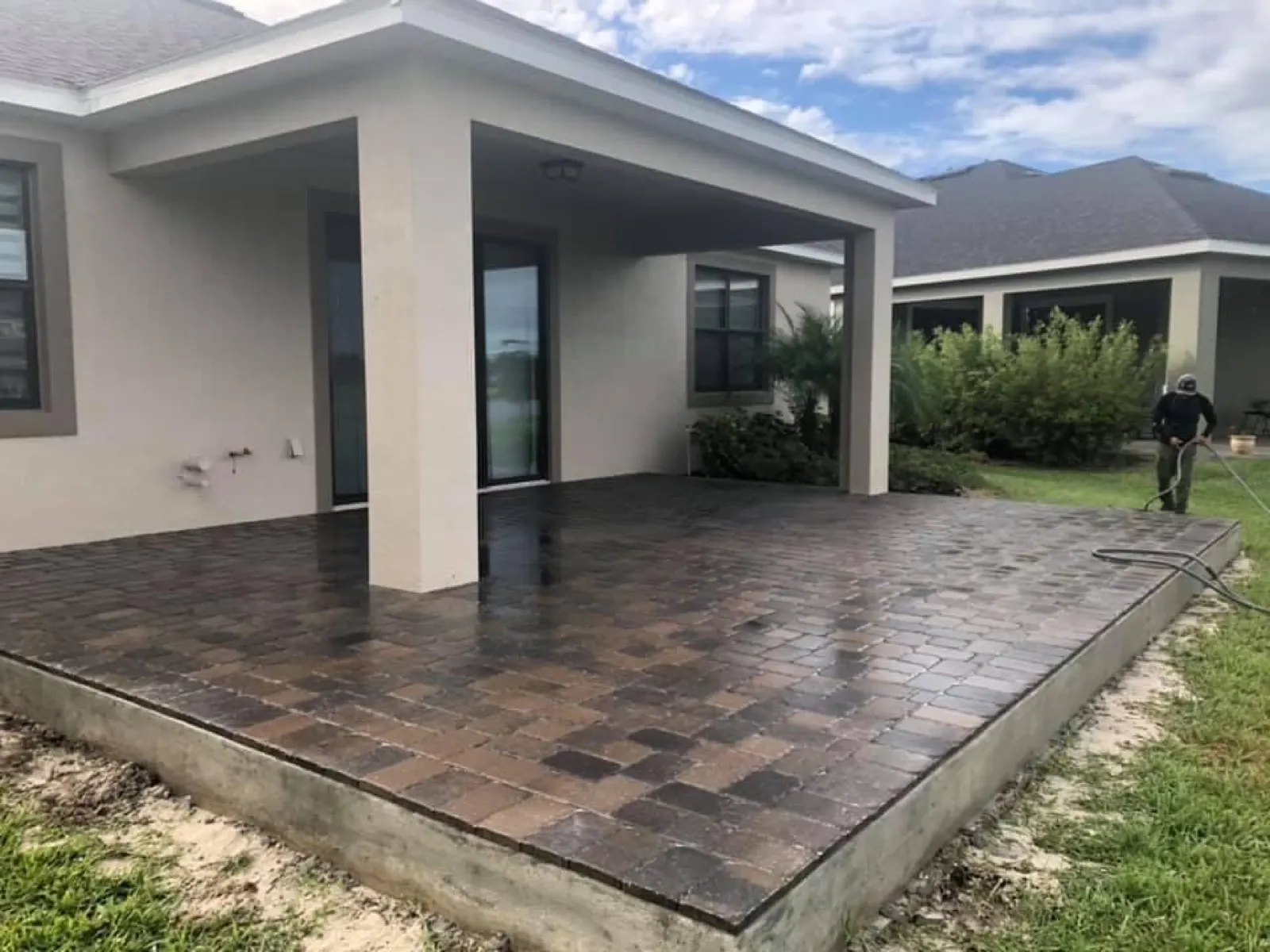
Polymeric Sand vs Regular Sand for Pavers in Brevard County
Polymeric sand is joint sand with a binder mixed in, and it hardens once the joints get watered. Regular sand is plain sand that stays loose. For most Brevard County paver patios and driveways, polymeric sand is the better fill. It just needs dry weather to set.
Polymeric sand is the joint fill on our own paver installs. Neither sand can hold up pavers that have already sunk or spread, though. If the same joints keep emptying after every storm, the problem sits under the stones. That calls for paver repair, with the stones pulled and the base rebuilt.
What is the difference between polymeric sand and regular sand?
Regular joint sand is plain sand swept into the gaps between pavers. Nothing binds it, so it stays loose. The best joint sand is a graded mix of angular, broken grains in different sizes. Those grains pack together and start to lock the pavers into one surface.
That sand does real work. It carries load from one paver to the next and cushions the stones against each other. When the joints run empty, the pavers lose that support.
Polymeric sand is graded joint sand with a binder blended in. Once it is swept in and watered, the binder sets and the joint hardens. It stays a little flexible, and water still drains through it.
The catch is that polymeric sand takes more time and more care to put down. The binder only works when the weather and the watering go right. On a paver patio or a paver driveway, that care buys joints that hold through storms.
How does each sand hold up in Brevard’s summer storms?
Most of Brevard’s rain falls from late May into October, and it comes in hard bursts. Regular sand does poorly in that weather. One maker warns that much of it will wash out after a few heavy rains.
Polymeric sand handles that weather once it cures. Before then, a downpour can still wash it out of the joints. Once it has fully cured, one maker says, it is typically immune to wash-out from a rainstorm.
Sandy ground adds a second problem. Brevard’s sandy soil drains fast, but loose sand travels when water runs through it. When the base under a paver moves, the stone drops and its joints open up.
How often does each sand need topping up?
Regular sand gets topped up by sweeping more into the joints. That is quick, but storms pull it back out, so the job comes around again and again.
Polymeric sand is made to harden and stay in place for a long time. It also cannot take a quick top-up. Makers want the old joint dug out first, to full depth or at least an inch and a half. A thin layer over old joints might get you through a season or two.
Pressure washing is hard on polymeric joints too. One maker warns that a pressure washer may knock hardened sand out of the joints.
If the same joints keep emptying, more sand will not fix it. The base or the edge restraint under them has usually let go. The stones get pulled, and the base gets rebuilt before the same pavers go back down. That is how we repair settled pavers, with new joint sand last.
How much dry weather does polymeric sand need to set?
Polymeric sand needs dry pavers and a dry forecast. The pavers have to be dry most of the way through. After three days of rain, one sunny afternoon is not enough. The water left inside wicks up and stains the stones.
The forecast matters just as much. One maker’s guide says to hold off if rain is expected within 24 hours. For joints wider than half an inch, it asks for 48 hours.
Another maker says a light shower is no problem. A real downpour in the first 24 to 48 hours can knock the sand loose, though. Summer storms pop up without warning, so the makers say to keep a tarp ready.
Water from the house counts too. The first guide says to keep sprinklers off near the new joints for at least 72 hours. The second warns that a downspout emptying onto a patio can cause trouble in the first few days.
Two makers’ guides agree on the wait after watering: 24 hours before foot traffic and 72 hours before cars. Heat and dry air speed the cure. Cool, damp weather and wide joints slow it down.
Haze is the other risk. Sand dust left on the paver face turns into a white film once it gets wet. Too much water can float the binder up onto the stones and leave the same milky look. The makers’ fix is to sweep the face clean, then clear the last dust with a leaf blower.
Makers say sealer goes on after the polymeric sand, since a stain sealed in is much harder to remove. When one of our own installs gets sealed, that is the last step.
What joint widths and depths does polymeric sand need?
Polymeric sand needs room to work, and the range varies by product. One maker rates its sand for joints from an eighth of an inch up to 4 inches wide. Another says its product works best on joints between a quarter inch and an inch and a half.
Depth matters as much as width. Polymeric sand works best filling the joint to the full depth of the paver. It stops about an eighth of an inch below the top, or at the bottom of a beveled edge.
Tight joints are the exception. Some pavers have small notches on their sides. When those notches touch the next paver, one maker says polymeric sand will not work well. The gap is too small to fill.
Does polymeric sand keep weeds and ants out?
It helps, and the makers word that claim with care. One says polymeric sand has the potential to reduce weed growth and help keep insects out, compared to regular sand. Loose, weak joints are open to both.
Deep roots are the limit. Some weeds grow strong roots that run under the pavers, so pulling the top does not end them. Where weeds are thick, one maker gives polymeric sand very little chance of stopping them.
Ants work from below too. One Florida pest ant, the bigheaded ant, nests in soil under bricks, slabs and walkways. It leaves piles of loose sandy soil where it digs, often along the edge where a lawn meets a walk.
A hardened joint is tougher for ants to dig through than loose sand. The nest still sits in the soil below, so ant control is a separate job from the joints.
Which sand belongs on a pool deck?
Pool decks take splash, and joint sand can wash low right at the pool edge. Loose, fine sand can also get tracked into the pool. That is one more reason our paver pool deck installs finish with polymeric sand.
One maker lists pool decks among the places its polymeric sand works, with one limit. The same guide says to keep it out of areas that stay underwater or wet all the time. Its joints can soften when soaked, then harden again as they dry.
The joint at the coping follows other rules. Where the deck meets set coping, the gap gets a flexible sealant over a foam backer rod. A sand filled joint passes deck movement into the coping, and polymeric sand cures semi rigid. Neither belongs there, as our post on pavers vs concrete for a pool deck explains.
Frequently Asked Questions
Can you put polymeric sand over old joint sand?
Not as a lasting fix. Makers call for digging the old sand out first, at least an inch and a half deep. A thin top layer over old joints might last a season or two. If the joints keep emptying in one spot, check for settled pavers first.
Can you use play sand between pavers?
It makes a poor joint. Play sand has coarse, round grains and tends to be dirty, so it is hard to install and keep stable. Fine silica sand has round grains of about one size, and it knocks loose under pressure. Joint sand works best as a graded mix of angular grains.
Why is there a white haze on my pavers after polymeric sand?
Usually sand dust was left on the paver face when the water went on. Too much water can also float the binder onto the stones, and damp pavers can stain. One maker says the haze fades over time or comes off with a concrete cleaner. A pressure washer can blow hardened sand out of the joints.
When can you drive on pavers after polymeric sand?
Plan on about three days. Two makers’ guides ask for 24 hours before foot traffic and 72 hours before cars. Cool, damp weather stretches that, and wide joints take longer to harden. Keep sprinklers off the new joints for those first three days too.