
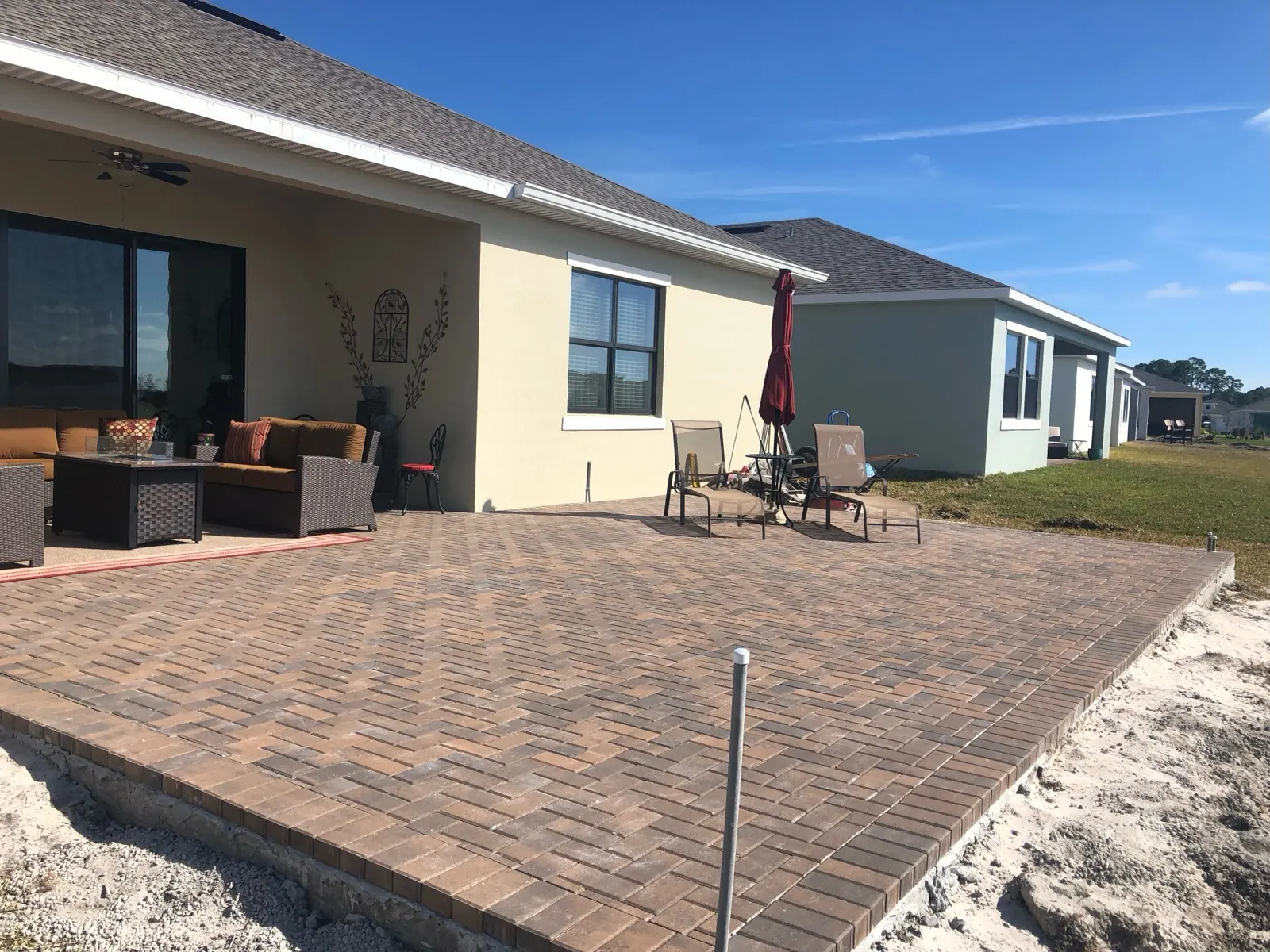
Herringbone vs Running Bond Paver Patterns in Brevard County
Herringbone is the stronger paver pattern anywhere cars drive. The paver industry’s application guide recommends 45 or 90 degree herringbone for areas with continual vehicle traffic. Running bond is one of its patterns for foot traffic. On a patio or a walk, you can pick on looks.
Based in Palm Bay, we lay herringbone and running bond, plus custom patterns with borders, across Brevard County. You pick the pattern and the color. The choice carries the most weight on a paver driveway, where tires load the pavers every day.
How do herringbone and running bond look different?
Both patterns use rectangular pavers. One paver maker says brick-shaped and plank-style pavers are commonly laid in one of these two. It calls them the most common patterns for patios and driveways.
Herringbone sets each paver at a right angle to the one beside it. The rows form a zigzag that runs across the whole field. On a large surface, one maker says that zigzag can feel dense and busy.
Running bond lays pavers end to end in straight rows. Each row shifts so its joints land between the joints in the next row. One maker compares it to the simple staggered pattern of a brick wall.
The lines set the mood. Running bond’s continuous straight lines suit a modern, linear house. Herringbone has a traditional look, and one maker says it can still work in the most modern yards.
Which paver pattern holds up best under car tires?
Herringbone. The industry guide recommends 45 or 90 degree herringbone where vehicles drive every day. It says these patterns provide maximum interlock and structural performance.
Interlock is how pavers share a load. Once the field locks together, a tire’s weight passes to the pavers around it. The guide says that load moves through the sand in the joints.
The same guide has a chart of typical laying patterns. It files running bond under patterns for pedestrian traffic. Only the two herringbone layouts appear under patterns for pedestrian or vehicular traffic.
So for a drive that carries cars every day, herringbone is the pattern to start from. The rest of the build is on our paver driveway installs page. One maker adds a design note. It calls herringbone ideal for wide driveways, since it creates interest from many angles.
Should you pick 45 or 90 degree herringbone?
Both angles sit on the guide’s list for vehicle traffic, so the choice comes down to looks and layout. In 90 degree herringbone, the pavers run square to the house and the garage door. In 45 degree herringbone, the whole pattern turns on the diagonal.
The diagonal means more cuts along the edges. Each paver that meets a straight edge gets cut on an angle to fit. Those cuts happen at a masonry saw, the way the guide describes.
Cuts come with a rule in a vehicle area. The guide says a cut paver there should be no smaller than one third of a unit. So the layout gets planned around the edges before the first paver goes down.
Either angle needs straight joint lines. The guide holds those lines to within half an inch over a 50 foot string line. One maker warns that herringbone is not an easy pattern to lay well.
Where does running bond work best at a Brevard home?
Running bond fits the spaces that carry feet instead of cars. Every pattern in the guide’s chart is listed for foot traffic. So on a paver patio, the choice comes down to looks and the shape of the space.
A covered lanai is a tighter space, closed in by walls and screen. One maker warns that herringbone may not be the best pattern where a space already feels packed in. In a lanai full of furniture, running bond keeps the floor calmer. Laid square to the walls, its edge cuts stay straight.
A pool deck carries bare feet, so any pattern works there. On a paver pool deck, the curve of the pool is the harder part. One maker points to slender pavers in running bond for curved spaces. It warns that the lines must be perfectly straight or deliberately curved.
A paver walkway can carry the driveway’s herringbone up to the front door. It can also switch to running bond inside a matching border, so the two areas still read as one design.
What about basketweave and multi-size layouts?
Basketweave sets rectangular pavers in side-by-side pairs. Each pair turns the other way from the pair next to it, so the field looks woven. It suits a patio or a walk, set inside a border.
The guide’s recommendation for continual vehicle traffic names herringbone, not basketweave. For a drive, we talk through that trade at the free on-site estimate.
Multi-size layouts mix two or more paver sizes in a set repeat. From a few steps back, the field looks random. The guide says the paver’s shape sets which laying patterns are possible. So a multi-size layout needs a paver line made in a set of sizes.
The guide also says to check with a local paver producer for available shapes and colors. On a driveway, its vehicle pick is still herringbone.
How do borders and edge restraint frame the pattern?
A border is a row of pavers run around the outside of the field. A soldier course is one such border, a single row of pavers framing the pattern inside it. The border can match the field or bring in a second color.
One maker suggests mixing two or three colors in herringbone to add interest. Some patterns also come with edge pavers, made to fit against the edge of the pavement. Without them, the pavers along the edge get cut to fit.
Outside the last row sits the edge restraint. The industry guide says a paver surface depends on its edge restraints to perform. They hold the pavers and the sand together, so the whole system stays interlocked.
That matters most under car tires, since herringbone’s strength comes from interlock. Our paver installs finish with edge restraint and polymeric sand joints. Our post on polymeric sand vs regular sand explains the joint fill.
Paver ribbon strips work like a border on their own. They widen a narrow concrete drive so a second car fits, as our driveway extension page shows.
How do you choose the right paver pattern?
Start with what drives on it. Herringbone at 45 or 90 degrees is the guide’s pick for a drive that carries cars every day. A surface that only carries feet can take any pattern.
Then look at the edges. A 45 degree layout adds cuts, and so does a curve. A straight-edged lanai stays simple in running bond.
At the free on-site estimate, we go through patterns and colors with you. You make the final pick, and we lay it out to fit the space. Call (321) 215-5817 to set one up.
Frequently Asked Questions
Can you use running bond on a driveway?
The industry guide lists running bond as a pattern for foot traffic. For areas with continual vehicle traffic, it recommends 45 or 90 degree herringbone for maximum interlock. So for a drive that carries cars every day, herringbone is the safer pick. Running bond can still carry the look up the walk and onto the patio.
Does herringbone need more cuts than running bond?
Usually, along the edges. The zigzag leaves a stepped edge, so the pieces along each side get cut to fit. A 45 degree layout takes the most, since every edge cut runs on an angle. On a driveway, the guide says no cut piece should be smaller than one third of a paver.
Can a paver pattern follow a curve?
Yes, with cut pieces along the curve. One paver maker points to slender pavers laid in running bond for curved spaces. It also warns that neither pattern is easy to lay well. On a driveway curve, each cut piece still has to be at least a third of a paver.
Can one project use more than one pattern?
Yes. One plan puts herringbone on the driveway, where the guide recommends it, and running bond on the patio or walk. A border in the same paver or a second color can tie the areas together. You pick the pattern and the color, and we lay it out with you at the free on-site estimate.