Pavers vs Concrete Patio: How Each Holds Up in Brevard County
Neither a paver patio nor a concrete patio wins in every Brevard County backyard. Concrete goes in faster as one clean slab, while pavers take longer and come apart for repairs. We build both, so one free on-site estimate prices both on your yard.
This post compares a plain poured concrete patio, with a broom or smooth finish, against a paver patio. Still deciding who should build it? Our page on patio contractors covers the work from the first visit to the finished patio.
Which holds up better on sandy soil and in summer storms?
Both hold up on sand when the base under them is built right. Most yards in Brevard County sit on sandy soil, which drains fast but shifts under weight.
A concrete patio is one slab, poured over sand that gets packed down first. A paver patio is many separate pavers set over a compacted base of crushed rock. That rock goes in layers, and a plate compactor runs over each one. Skipping that step is why patio pavers sink at the corners a few years in.
Edge restraint around the perimeter keeps the outside rows of pavers from spreading. The concrete paver industry’s own care guide says loose or weak edge restraints let pavers move apart.
Storm water is the other test. Brevard storms drop inches of rain in an hour, and that water has to go somewhere. We grade every concrete patio to move that water away from the house. A paver patio pitches away from the house too, so storm water runs to the yard.
On a concrete patio, the fall runs away from the house and away from the lanai door. On a flat Palm Bay lot, we sometimes tie paver runoff into a swale or a drain line.
How does each patio crack or settle, and how is it fixed?
Concrete cracks and pavers settle, and the repairs look very different. Concrete shrinks as it cures, so fine cracks show up over time in any slab. A concrete industry guide on slab joints says cracks in concrete cannot be prevented entirely. It calls joints simply pre-planned cracks.
We saw cut control joints within 4 to 12 hours of finishing, so the slab cracks in straight lines. The same guide says irregular cracks look untidy but generally do not affect how sound the concrete is.
New concrete will not match old concrete in color. The old slab has years of sun and dirt on it, so a patch can still read as a patch. On a sound slab, patio resurfacing can bring old and new to one surface.
A paver patio has no single slab to crack. The paver guide says settling is often caused by soil or base that was not compacted enough. So the fix starts below the surface.
We lift those pavers, rebuild the base and reset the same stones. The guide says removed pavers can go back with no wasted paving materials or unsightly patches. A broken paver gets swapped for a matching stone.
How long does each patio take before you can use it?
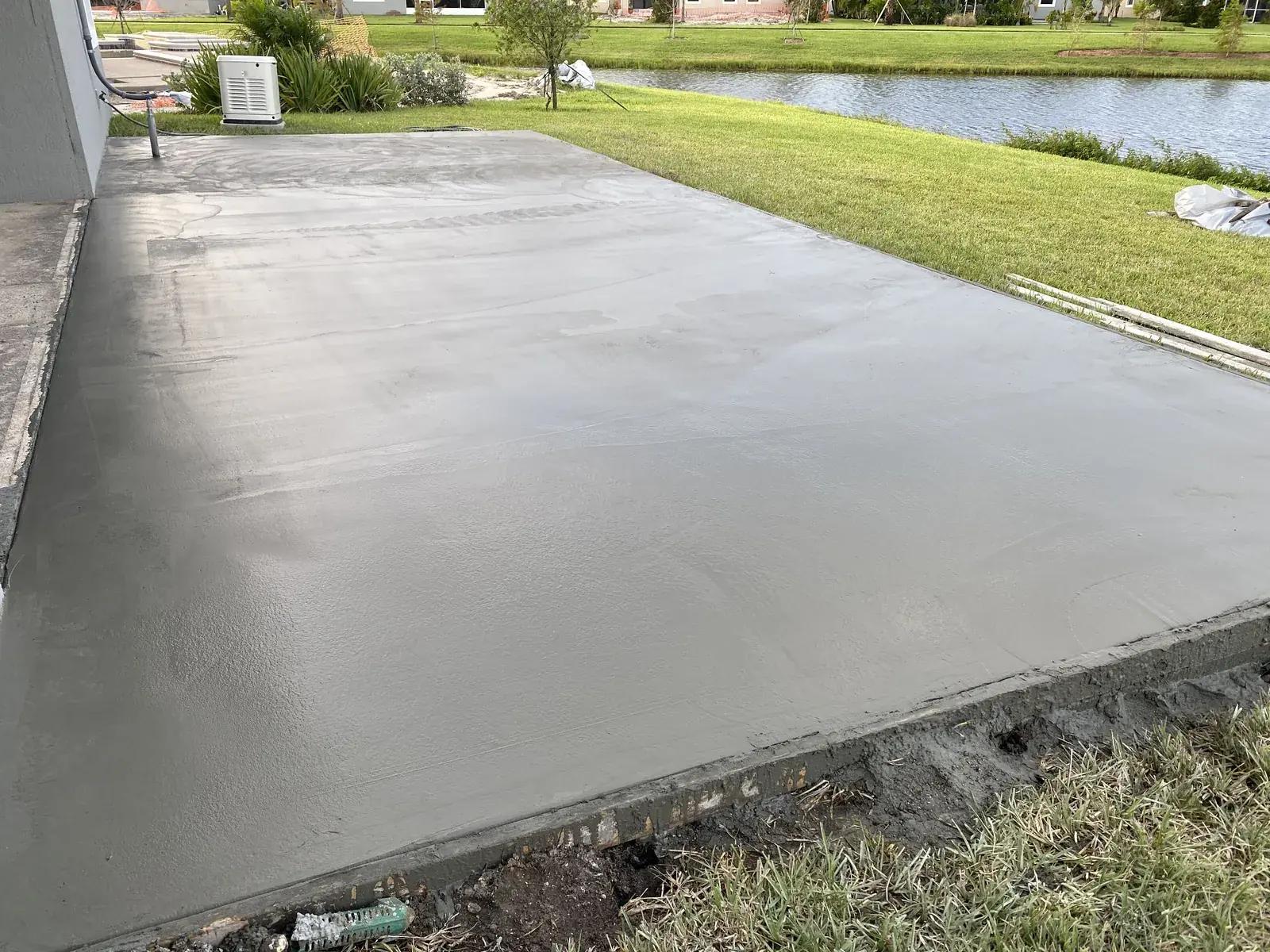
Most backyard concrete patios take one day of prep and one day to pour. You can walk on the slab after about a day. Furniture can go back after a few days, and full strength comes at about a month.
Most backyard paver patios take three to five working days. Demo and excavation take one day, and base rock takes one or two. Laying and jointing the pavers comes last. Once the joint sand has had a day to set, the patio takes foot traffic and furniture.
So concrete is the shorter build with a longer wait, and pavers are the reverse. Count to the day the furniture goes back, and the two land closer than the build days suggest.
Weather moves both schedules. A pour needs a dry window, and August afternoons do not always give one. Rain pushes a paver job too, and summer storms in Brevard County are part of the plan.
Which is cooler underfoot, pavers or concrete?
On either patio, color is where the Florida sun matters. Light colors reflect more sun, and dark colors absorb more heat.
On a paver patio, light tans and grays stay cooler underfoot. Darker charcoal and red tones look sharp but soak up July heat.
On a concrete patio, integral color mixes into the concrete, so the tone runs all the way through the slab. A dark integral color takes on heat the way a dark paver does.
Texture matters for bare feet too. Broom finish is the standard for a concrete patio in Florida, with fine lines that give grip. Smooth trowel looks cleaner, but it turns slick under bare feet when it rains.
Pavers give you more looks to pick from. Pattern sets the look before color does, and a border in a contrasting color frames the patio. A pattern pressed into one poured slab is stamped concrete. Our post on stamped concrete vs pavers compares those two.
Which patio takes more upkeep?
Pavers ask for joint care that a slab does not. Polymeric sand in the joints hardens when wet and helps keep weeds and ants out. Runoff can still wash some joint sand away over time. When the joints wear low, the old sand gets dug out before fresh polymeric sand goes in.
The paver guide says weeds start from windblown seeds lodged in the joints. Beyond the joints, rinse the patio off and pull the odd weed. Our post on polymeric sand vs regular sand covers joint sand in detail.
A concrete patio has no joint sand to top up, since its control joints are saw cuts in the slab. Sealing is optional on pavers, where it deepens the color and makes cleanup easier. If you seal either patio, plan on resealing about every six years, sooner in full sun all day.
What changes under a screened lanai or with a future screen room?
Both patios can go under a screened lanai. Plenty of Palm Bay homes came with a small slab under the lanai, and we pour extensions off those slabs. Under-lanai paver patios are common here too, and the work goes around the screen track and post footings.
We keep the finished paver height level with the door threshold, so you step straight through. No machine fits through a screen door, so material comes in by wheelbarrow or gets pumped in.
Screen rooms bolt into the slab, so the edge has to be thick enough to hold the track. Tell us before the pour if a screen enclosure might go up later. We can set the slab size and the finish so the frame lands on solid concrete.
Have a sound lanai slab you would rather cover? Our guide to lanai flooring options compares those choices.
Pavers or concrete: which patio fits your yard?
Weigh repairs first. Pavers win when you want a surface that can be lifted and reset later.
Then look at the surface you want. One clean surface with a broom finish points to a concrete patio. A pattern laid in separate stones points to a paver patio.
Check the permit question too. In Palm Bay, a concrete patio that stands on its own goes to Zoning. West Melbourne’s permit list has an entry for driveways, pavers and patio concrete slabs. Outside city limits, check with the county building permits office.
Our driveway and patio permit guide has the detail. The question for your lot gets settled at the free on-site estimate.
We do pavers and concrete under one roof, so both options get priced on your project. Our page on hiring a patio contractor covers what a written bid should spell out. We are based in Palm Bay and work all of Brevard County and across Florida. Call (321) 215-5817 or book a free on-site estimate.
Frequently Asked Questions
Is a paver patio better than a concrete patio in Florida?
Neither one is better in every yard. A concrete patio goes in faster and gives you one clean surface. A paver patio takes longer to build, but a settled section comes up and the same stones go back down. On a Brevard County lot, the deciding question is often whether you want easy spot repairs or the faster build.
Which lasts longer, a paver patio or a concrete patio?
Both hold up for decades when the base under them is built right. The concrete paver industry’s own care guide says pavers can last for generations on a well-prepared base. On a concrete patio, the base under the slab and the steel inside it are what hold up over time. The bigger difference is how each one gets repaired.
Can you add on to a concrete or paver patio later?
Yes. A concrete extension gets poured against the existing edge, with a joint that lets each slab move on its own. The new concrete will not match the old color. With pavers, Florida UV fades any paver over time, so new stones can look brighter at first.
Can you replace an old concrete patio with pavers?
Yes, and a failed slab gets broken out and hauled off first. The sand gets graded and compacted, and the paver patio goes in on a new base. If the slab is sound, thin pavers can go straight over it instead, which is a paver overlay. Either way, we look at the slab first at the free on-site estimate.